Chemistry sample
Why does a cut apple slowly turn brown?
Why cut apples turn brown
Follow the enzyme-driven oxidation that begins when cutting an apple brings oxygen, phenolic compounds, and polyphenol oxidase together.
Reviewed 2026-08-10 · 4 minute read
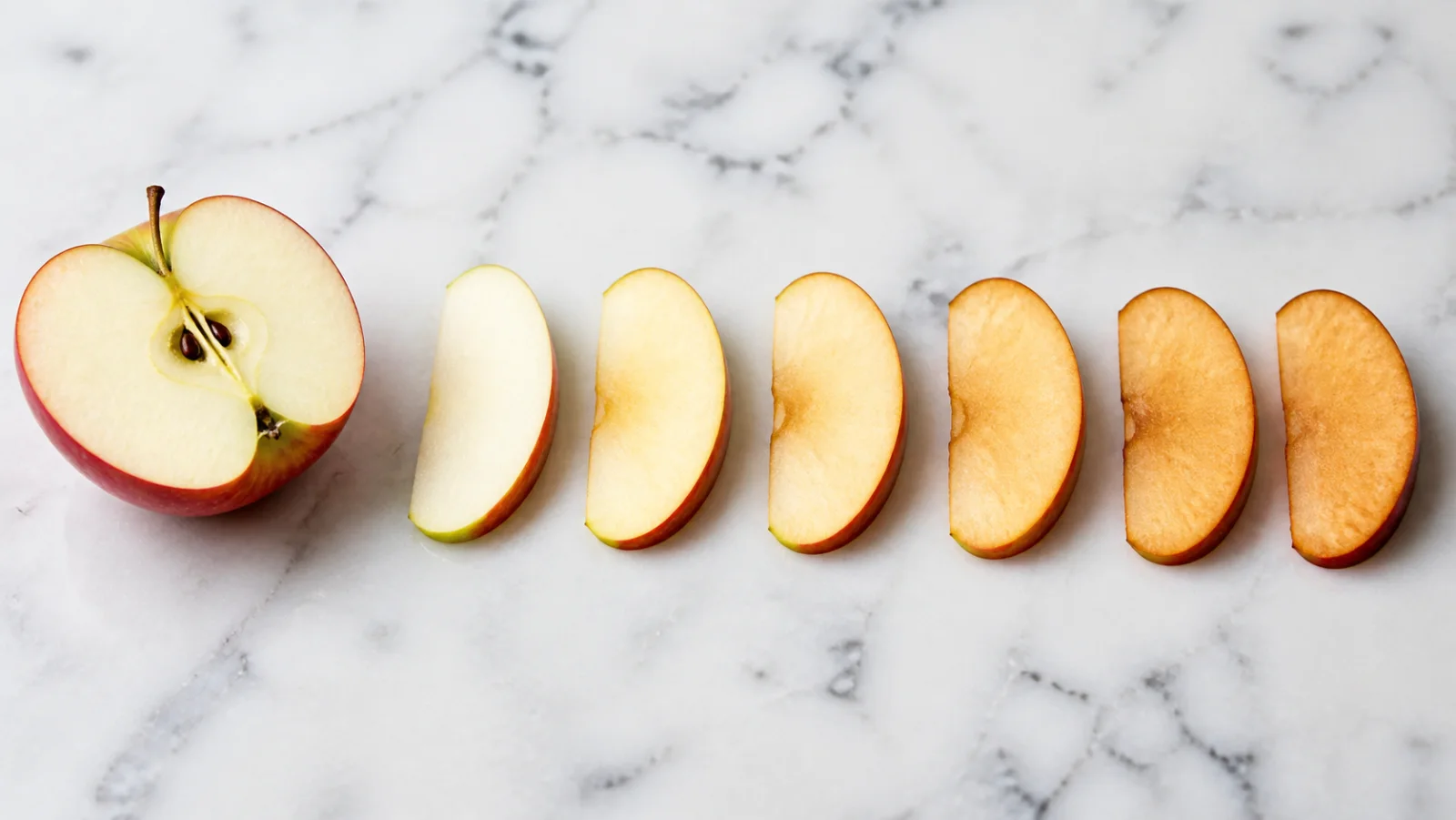
Core principle
Cutting breaks open apple cells and brings polyphenol oxidase, phenolic compounds, and oxygen together. The enzyme speeds oxidation reactions that form reactive quinones, which then participate in reactions that create brown pigments.
What the image shows
- The exposed flesh ranges from pale cream to increasingly brown across the slices.
- Browning appears mainly on cut surfaces, where cells have been damaged and exposed to air.
- The colored skin changes much less than the freshly exposed flesh in this sequence.
Mechanism and evidence
- Inside an intact apple, cell structures keep many reactants separated. A cut or bruise disrupts those structures.
- Oxygen from the air reaches the wet cut surface while polyphenol oxidase, often shortened to PPO, contacts naturally occurring phenolic compounds.
- PPO catalyzes the oxidation of those compounds into quinones. The enzyme speeds the reaction without being consumed by it.
- The quinones continue reacting and form larger colored products, so the surface becomes visibly brown over time.
Useful relationships
\text{phenolic compounds} + O_2 \xrightarrow{\mathrm{PPO}} \text{quinones} \rightarrow \text{brown pigments}This is a pathway summary rather than one balanced chemical equation: PPO assists oxygen-driven oxidation, followed by additional pigment-forming reactions.
Variables that could change it
- Apple variety and ripeness
- Available oxygen at the surface
- Temperature and time since cutting
- Acidity of any treatment
- Amount of tissue damage
- Natural PPO and phenolic concentrations
Limits in this image
- The image is a generated time-sequence illustration, not a controlled experiment with measured elapsed times.
- Color alone cannot identify the exact apple variety, treatment, or reaction rate.
Sources and review
- Slowing Apple Browning — American Chemical Society
- Polyphenol Oxidases and Their Application in the Food Industry — National Library of Medicine, PubMed Central
Reviewed by SciLens source review on 2026-08-10. Suggest a correction.