Biology sample
How can a leaf help pull water upward through a plant?
How leaves pull water upward
See how transpiration, stomata, cohesion, and xylem connect evaporation at a leaf to water movement through a plant.
Reviewed 2026-08-10 · 5 minute read
Core principle
Evaporation from moist cell surfaces inside a leaf and diffusion of water vapor through stomata create tension in the plant's water-conducting xylem. Cohesion between water molecules helps that tension pull a continuous water column upward.
What the image shows
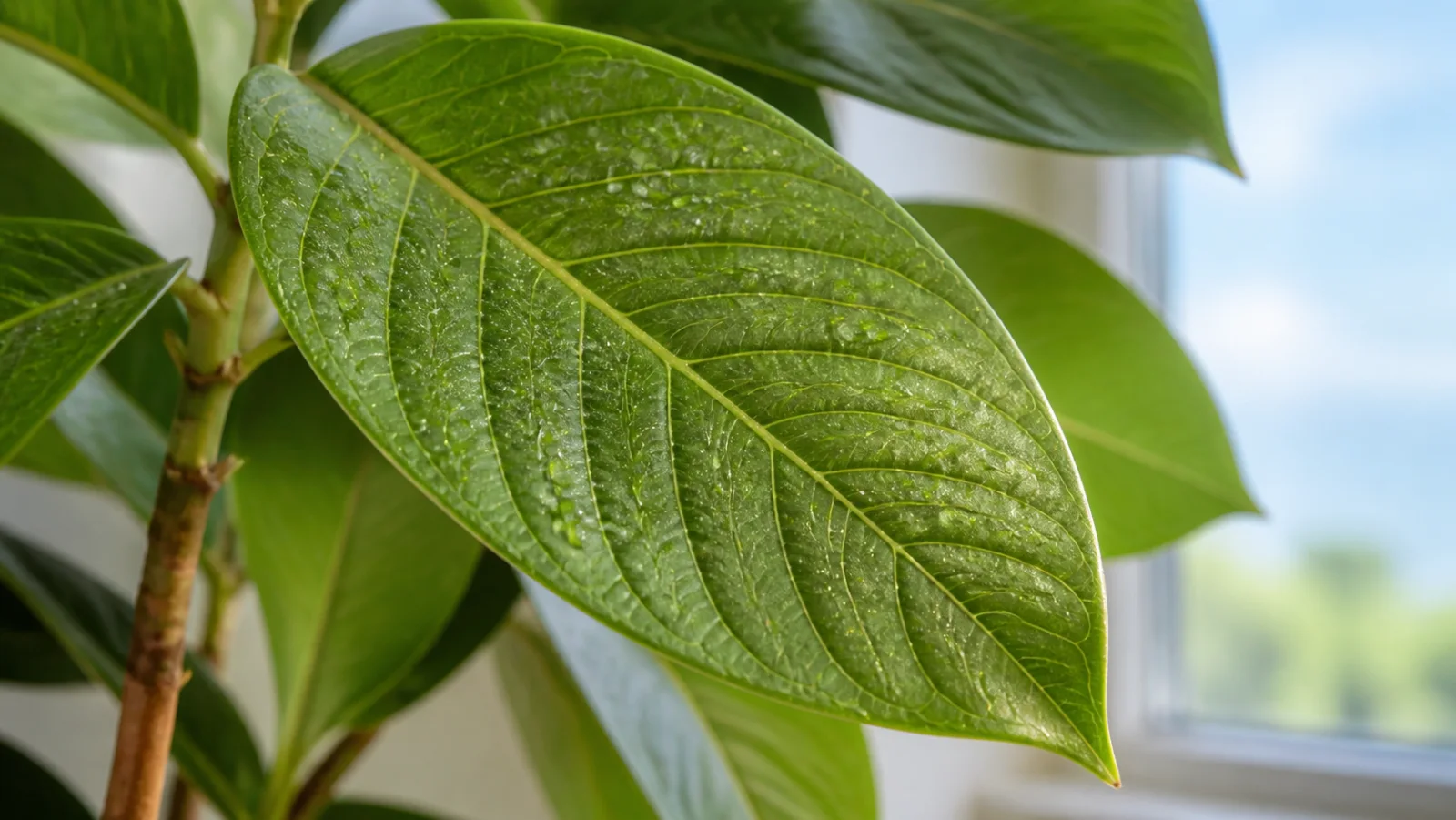
- A branching network of veins spreads from the central vein into smaller parts of the leaf.
- The leaf looks hydrated and structurally supported rather than wilted.
- Surface droplets are visible, but droplets alone do not prove transpiration because they could come from mist, rain, or condensation.
Mechanism and evidence
- Roots absorb water from the soil, and the water enters xylem, the tissue that conducts water and dissolved minerals upward.
- Inside a leaf, water evaporates from moist cell surfaces into air spaces. Water vapor then diffuses out through microscopic pores called stomata.
- That water loss lowers pressure in the leaf xylem. Because water molecules cohere to one another and adhere to xylem walls, the tension can be transmitted down the continuous water column.
- Water is pulled upward to replace what was lost. Guard cells adjust stomatal openings, balancing carbon-dioxide intake for photosynthesis against water conservation.
Variables that could change it
- Humidity and air temperature
- Wind speed around the leaf
- Light level and stomatal opening
- Soil moisture and root health
- Plant species and leaf area
- Continuity of the xylem water column
Limits in this image
- The image is a generated teaching illustration; stomata and xylem flow are too small or internal to see here.
- Visible droplets sit on the outer surface and are not direct evidence of vapor leaving through stomata.
Sources and review
- Evapotranspiration and the Water Cycle — U.S. Geological Survey
- Transport of Water and Solutes in Plants — OpenStax
Reviewed by SciLens source review on 2026-08-10. Suggest a correction.